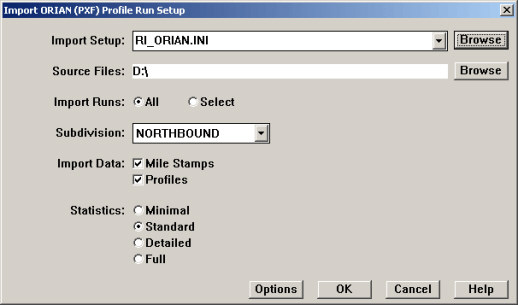
To import and process run data from ORIAN .PXF files, select Profile/Import/ORIAN PXF from the Run menu of the Profile View window. This dialog will appear:
Ensure that there is an INI file for the ORIAN import in the CFG folder for your Rangecam installation. The INI file contains data-importation rules. The name of an INI file for importing ORIAN data starts "RI_ORIAN", for example, "RI_ORIAN1.INI". If Rangecam cannot find the INI file, the import will not proceed.
The INI file RI_ORIAN.INI, containing default settings, is installed with the Rangecam Office System. Instead, you may use an alterative INI file containing data-importation rules customized to your requirements. If the customized INI file is in your configuration folder, you may select it using the Browse Button to the right of the Import Setup drop-down. If you require a customized import INI file, please contact Industrial Metrics.
In the Source Files field, enter the path to the folder containing the ORIAN .PXF run data files; or set the path by using the Browse button to select any .PXF file in the folder.
You may import all runs in the selected folder, or click the Select button to choose individual runs. You may also import partial runs by entering a specific mileage range.
You must specify the subdivision to which the run data belongs using the list button. The subdivision record must have been previously recorded in the database, and the direction of increasing mileage must be correct. Refer to the section Subdivision in Database Maintenance on how to add a subdivision to the database.
Check Mile Stamps to import mile stamps and update the Location database table that contains distances between mileposts. This should be done at least once for each territory. The Location table will always reflect the last run imported with mile stamps. If importing data from different data collection runs covering the same territory in different years, it is recommended that you import mile stamps for one year only - the one for which the mile stamps are most trusted.
When runs are processed, statistics are collected on successes and failures of rail modeling, rail recognition, and measurement calculations. The statistics are displayed in the Log Window and saved in the daily log file. They contain information that you can use to optimize run processing.
The setup dialog allows you to choose the level of statistical reporting. The choices, in increasing level of detail, are Minimal, Standard, Detailed, and Full. The Standard level is recommended if you are getting started. Interpreting the Import Run Statistics explains how to interpret and use the statistics.
The Options button opens the Modeling Options Dialog, allowing you to specify parameters affecting processing.
After you click OK, you will be prompted to select rail weights.
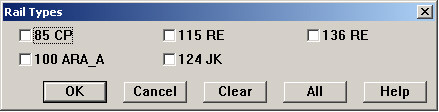
Available rail types must have previously been imported to the database. For faster processing and maximum success in rail recognition, select only rail weights that are believed to be in the imported data.