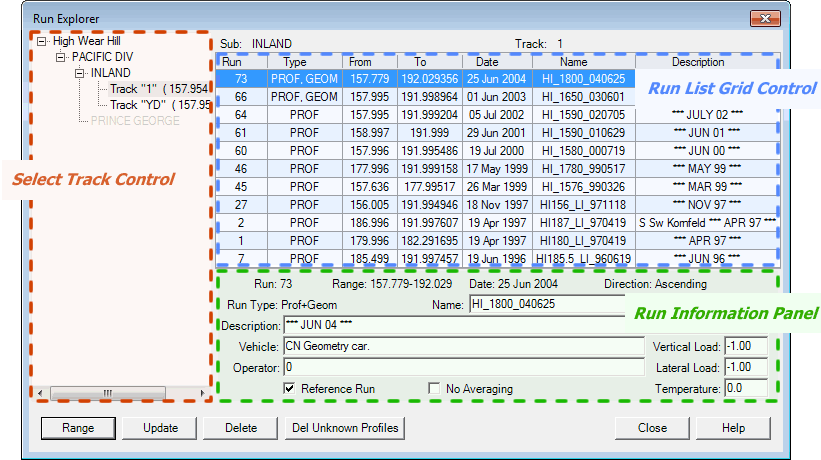
Run Explorer is used to look up and maintain the Run table. The user selects the track of interest in the Select Track Control panel on the left. Run Explorer automatically shows all available runs for a selected track Run List Grid Control on the right. Basic run information is displayed in this grid. When a run is selected, the detailed run information appears in the Run Information Panel, as shown below. The Run Information Panel includes a description of the vehicle, company and operator that collected the data.
The Run Explorer Dialog allows the user to look up and modify the Run table
The Run table maintenance dialog is unique in several respects.
In the Office System, a run record is added to the database when a run is imported from field data (see Processing and Editing Functions) or from another database. There is no Add button.
Also, many fields are maintained by the system, and cannot be manually updated. Run direction must be entered correctly during field data collection. Subdivision may be changed, but only if the direction of increasing mileage is the same. The run number, its primary identifier, is assigned by the system. Run date is the system date in the field system when the data was collected.
The user may update the run name, description and the other text fields by clicking the Update button.
The range of mileage locations included in the run is system-maintained. However, it may be manually refreshed by clicking the Range button. This causes the range to be recalculated from the locations of the profile and/or geometry records in the run. It may be useful if data has been deleted from either end of the run during editing. It is not necessary to update the range manually if runs have been spit or joined (see sections Joining Runs and Splitting Runs),
It is possible to change the subdivision to another subdivision with the same direction of increasing mileage. The track code can also be changed. If a subdivision or track is updated, and the database contains exceptions, track segments or track points associated with the run, these and related records will also be updated with the new subdivision or track.
The Delete button deletes not only the run header record, but the individual profiles in the run, and all other records that refer to the run, including entries in a grinding plan! Do not delete a run unless you are sure that its profiles are not referenced in a grinding plan that you wish to keep. If you wish to recover disk space after deleting runs, you may compact the database (see Database Management).
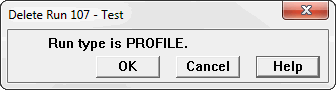
If the Delete button is clicked, the user is asked for confirmation.
The Del Unknown Profiles deletes all unknown profiles from the selected run.
The Range, Update, Delete and Del Unknown Profiles buttons might be blocked if the dialog is used as a viewer. This can happen if the database is read-only or if the product is configured to protect data from modification.
The No Averaging checkbox is used to exclude specific runs from the calculation of average values used in wear trend calculations. You may use it if you have low confidence in the accuracy of a particular data collection run but do not want to delete it from the database. If No Averaging box is checked when averages have already been calculated, you will be warned that averages for the run will be deleted if you proceed with the update.
The Reference Run checkbox may be used to select or de-select a run as a reference run for purposes of rail section identification and run alignment.
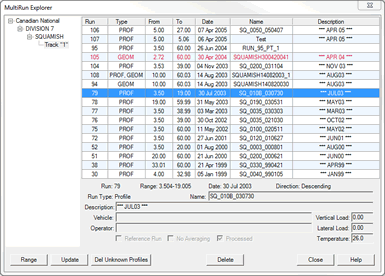
The Run List Grid Control allows the user to select multiple runs. Multiple selection can be done in the same way as multiple selection in Microsoft Windows Explorer: user can use Ctrl + mouse left click to add one more run to selection, Shift+Ctrl+ mouse left click to select the range of runs, Ctrl+A to select all runs.
Multiple selection turn on another view (Run Overlay Control) that visualizes runs that overlay. Figures below show the difference between one selection and multiple selection modes.
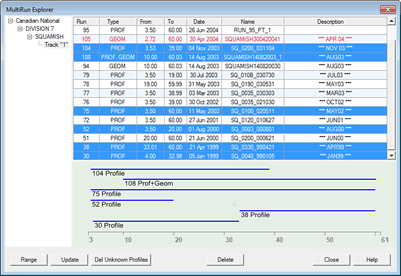
The Overlay Control is resizable. If the user drags the top, left side of the control or right-bottom corner of the whole dialog box, the overlay automatically changes its layout.
The Overlay Control has a zoom option. The mouse wheel can be used to zoom in/out of the area around mouse cursor location. If mouse is shifted between zoom in and zoom out actions content does not return to the original location. To recover the original layout, it is enough to change/repeat the selection in the Run List Grid Control.
The Overlay Control supports "drag"operations: a user can click and hold left mouse button and drag information with the mouse. This feature is used to zoom in to see more detailed information.
When several runs are selected, the user can perform operations, such as delete, update, update range, delete unknown profiles etc., for multiple runs.
The Run Update Dialog shows only fields that have the same value. For example if runs have the same "Lateral Load" property, only "Lateral Load" field has a value. If properties are different, the corresponding field remains empty.
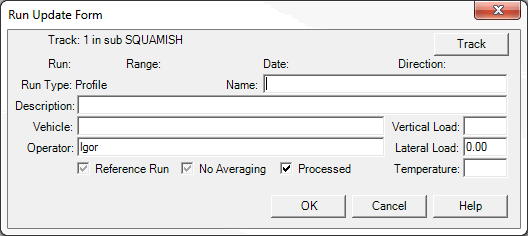
In the given example all selected runs have the same Operator, Lateral Load, and Processed properties. All other properties have different values for different runs.
When the user populates a field the modification is recorded and updated it as soon as user click OK.
WARNING: if the user types, then erases something in a field, the software interprets this action as an intention to update the property with an empty string. In these cases it is better to cancel and redo an operation. The "Name" field must be unique and cannot be updated for multiple runs.
The Dialog Run Explorer supports a context menu which depends on selection, database status (updateable / non-updateable) etc. The typical menu has items: Chart, Calculate All, Join, Update Range... To open it select one or several runs and click the right mouse button.
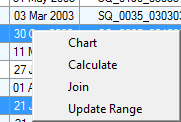
The following selection convention is used:
This order might be important when the user wants to open a chart from the Run Explorer directly. The chart also allows the user to change the main run (with some restrictions) later.