The segment options affect rail modeling.
If Flyer Removal is checked, then short contour fragments, which do not appear to be part of the surface of the rail, are filtered out at the start of the modeling process. Several other options in this section are related to detecting 'flyers'.
Minimum Gap is the smallest distance between adjacent points that is treated as a break in the contour. Points that are closer together than minimum gap are assumed to belong to a continuous contour. The minimum gap should always be set to a distance greater than the normal distance between two adjacent x, y points.
Minimum Length is the minimum length of a contour fragment to be included in the modeled rail profile. Any continuous fragment shorter than minimum length is discarded.
Flyer Length is the maximum length of a continuous contour fragment that is considered a flyer.
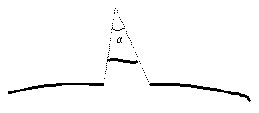
Flyer Angle is an angular value used to test for flyers. Intuitively, a flyer is a contour fragment that is "off the surface of the rail". The software tests the angle a between the lines projected from the gaps on both sides of a segment.
If that angle is less than flyer angle, then the fragment is considered a flyer.
Head-Web Gap is a distance value used to distinguish between the head and the base portions of a rail profile. There is always a gap in the contour between head and web because the cameras are above the rail, and the underside of the head cannot be seen. The measured portions of the head and the web must be separated by at least the head-web gap. The value should be set to allow for heavily curve-worn rail, and for head-free rail if it is present.
Thinning options allow you to reduce the disk space required to store profile data. Different values are recommended for the head and base portions of the rail. Head Thinning should be set to a low value to preserve detail in the shape of the rail head. In the example, it is set to 0.001", meaning that if three or more consecutive points lie within 0.001" of the line that connects the first and the last point, the intermediate points will be dropped from the rail model. The shape of the modeled head will still conform to the original measured points to within 0.001", which is probably close to the resolution of the measurement system. To reduce data volumes, Base Thinning may be set to a higher value, since the fine detail of the base shape is less important.